Every moving company pays to get customers to its website: ads, SEO, directory listings. Then most of them lose those customers on the quote form.
Our launch partner, JP Urban Moving in New York, had exactly this problem. According to JP's marketing team, less than half of the people who started the old quote form finished it. That's half of the paid traffic lost on the last step before a lead.
We rebuilt the form from scratch. Over its first three months live (July 1 to October 10, 2026), here's what happened:
- 1,712 customers started a quote
- 1,348 finished it: a 79% completion rate
- 364 stopped partway, and every one of them still became a lead (more on that below)
Completion went from less than half to 79%.
Why moving quote forms lose people
Moving forms ask a lot: addresses, dates, floors, elevators, and then the hard part, the inventory. JP's old form handled it the way most movers do: one very long list of item names, each with a + and – button. Dozens of categories, hundreds of rows. Twelve phone screenshots of it still don't reach the bottom.
The customer has to scroll the whole list, read every name, and decide which line is their furniture, usually on a phone. So they quit and call the next company on the list, or nobody at all.
What we changed
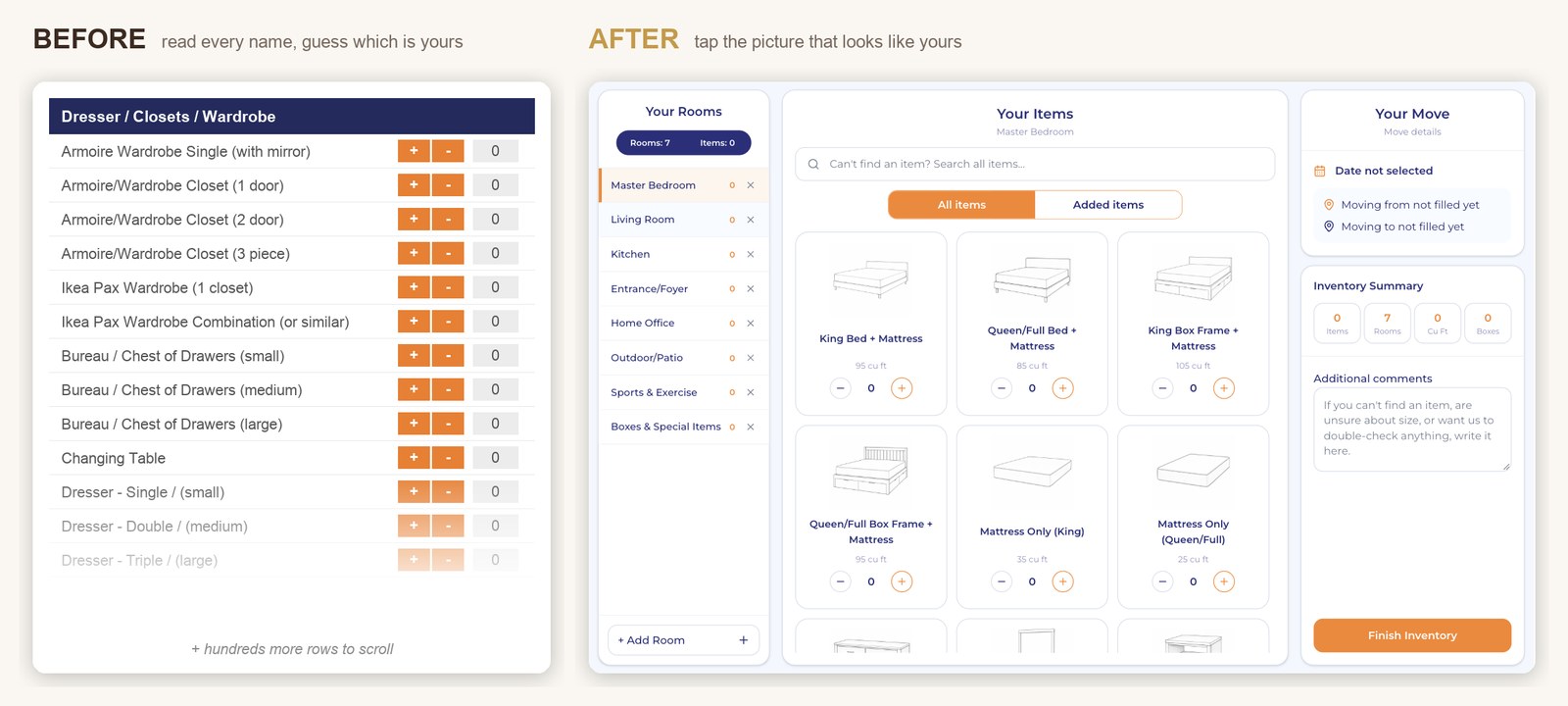
1. Pictures instead of furniture jargon. The old list asked customers to choose between items like "Dresser – Triple / (large)", "Bureau / Chest of Drawers (medium)", "Armoire/Wardrobe Closet (3 piece)" and "Storage Unit (12 Cubes)". Is your dresser a "triple" or a "bureau"? Most people don't know, and they shouldn't have to. The new form shows a simple drawing of each piece. A queen bed looks different from a king; a sectional looks different from a loveseat. People recognize their own furniture at a glance, which makes the form faster and easier for everyone, including customers whose first language isn't English.
2. The customer picks how to share their inventory. Not everyone wants to build a list item by item, so the form offers five ways to do it:
- tap pictures room by room
- type or paste a list in their own words
- upload a file they already have (PDF, Excel, Word, CSV)
- get a text link and film their home on their phone
- schedule a live video walkthrough with the moving team
Customers who would have quit at a long checklist now just choose the option that suits them.
3. It feels interactive, not like paperwork. As customers add items, the cubic-feet estimate builds in front of them. They can see where they're headed, and the mover gets a usable volume number instead of a vague list.
4. The basics come first, so no lead is wasted. Name, email and phone come before the inventory, the longest part of the form. So the moving company has the customer's contact details even if they stop partway. If a customer goes quiet for 20 minutes, the form automatically sends everything they've entered into the mover's CRM as a lead, tagged so the sales team knows to follow up. An "abandoned" form is no longer a lost customer. It's a warm lead with an address, a home size and a phone number.
What the numbers mean (and don't)
We count a session once a customer has entered their contact details. People who glance at the first screen and leave aren't in these numbers. So this measures what matters to a sales team: of the customers who actually started asking for a quote, how many did we lose? The answer went from about half to about one in five. Even that one in five reaches the sales team.
Why this matters for your bottom line
If you spend $5,000 a month on leads and your form loses half of them, you're really paying double for every lead you keep. Going from under half to 79% completion means roughly 60% more finished quote requests from the same ad budget. Then add back the partial leads that used to vanish entirely.
The form is the cheapest place in your business to find more jobs. You've already paid for the visitor.
ForgeMove builds AI-native tools for moving companies: visual intake forms, AI phone agents and video walkthrough inventories. See the visual intake form, or book a demo to see it running.